Thursday, May 14, 2026

An Infinite Number of Monkeys: Douglas Adams and the Crucible of Conservation


The gorillas were not the animals we had come to Zaire to look for. It is very hard, however, to come all the way to Zaire and not go and see them. I was going to say that this is because they are our closest living relatives, but I'm not sure that that's an appropriate reason. Generally, in my experience, when you visit a country in which you have any relatives living, there's a tendency to want to lie low and hope they don't find out you're in town. At least with the gorillas you know that there's no danger of having to go out to dinner with them and catch up on several million years of family history.” 

 — Douglas Adams, Last Chance to See 

On a hot August night in 1998, Douglas Adams and I strode along a boulevard in Santa Barbara. He had relocated there to oversee Disney’s script rewrites for the movie production of The Hitchhiker’s Guide to the Galaxy. We had just enjoyed a lavish vegetarian meal at Emilio’s bistro, with tech and film creatives Kai Krause, Savannah Brentnall, Jody Boyman, Berkeley Breathed, and Mike Backes, during which I regaled them with highlights of journeying down the Pacific Coast Highway, meeting influential people in Silicon Valley and pitching our appeal to Bill Gates. “Timing is everything,” I said. “I mean, showing up in Cupertino on the day they launched the iMac was fortuitous. They were easily coerced into donating a few more Macs.” 

“How many AppleMasters have joined the cause so far?” asked Douglas. An offshore breeze blew, and the air was infused with orange blossom and sea salt. Tall fan palms lined the boulevard, silhouetted against the pastel hues of twilight reflected on the Pacific Ocean. 

“Let me see,” I said proudly. “Michael Crichton, Richard Dawkins, Michael Kamen, John Perry Barlow, Michael Backes, you…” 

“An orchard,” quipped Douglas. 

“Couldn’t have done it without you, mate,” I smiled, patting him on the back. 

 ~~~ 

British writer and humorist Douglas Adams is best known as the creator of The Hitchhiker’s Guide to the Galaxy, which evolved from a BBC radio comedy into a “trilogy” of six books that sold more than 15 million copies. His work blended science fiction, absurdist comedy, and philosophical wit, turning the cosmos into a backdrop for jokes about bureaucracy and the meaning of life. Beyond Hitchhiker’s, he wrote the Dirk Gently’s Holistic Detective Agency series, scripted for Doctor Who, dabbled in far-reaching tech projects, and championed endangered species — which resulted in his favourite book, Last Chance to See

Toweringly tall, famously procrastinatory (who can forget the “whooshing” sound of a deadline flying past?), and deeply curious about science, Douglas had a rare knack for making the absurd feel profound. He was a self-proclaimed “radical atheist,” adding “radical” for emphasis so he wouldn’t be asked if he meant agnostic. 

On 11 May 2001, after resting from his regular workout at a private gym in Santa Barbara, California, Douglas died of a heart attack due to an undiagnosed coronary artery disorder. He was 49. His funeral was held on 16 May in Santa Barbara. A memorial service was held on 17 September 2001 at St Martin-in-the-Fields church, London — the first church service ever broadcast live on the web by the BBC. His ashes were placed in Highgate Cemetery in north London in June 2002. 

~~~

Last September, I visited Douglas’s gravesite with his long-time assistant Sophie Astin. We met at The Flask pub on London’s Highgate Hill. She was sitting in the beer garden, sheltering from the downpour with a glass of wine in her hand. We hadn’t seen each other in nearly a quarter of a century. Despite the solemn purpose of our reunion — a visit to Douglas Adams’s gravesite — the mood was decidedly bright and cheery. We embraced. 

“Has it really been that long?” asked Sophie. Her smile and piercing sapphire eyes were a tonic to my jet lag. 

“Not since Douglas’s wake at the Groucho Club in 2001,” I said. I rubbed my travel-weary eyes. She hadn’t aged much. Dressed in white sneakers, black track pants, and a grey camo jacket with a dragon motif, she positively glowed. 

When the rain ceased, we set off walking to the cemetery. Sunlight burst through the clouds, glistening on the fallen leaves of autumn. Everything sparkled. 

At the entrance to Highgate Cemetery East, we joined a queue of visitors. A tall, hirsute man from the Friends of Highgate Cemetery approached us and asked if we had tickets. 

“We’ve come to visit a friend’s gravesite,” I said, “but we don’t have a grave pass.” 

“Don’t worry,” he said. “You can go right in.” 

“Cheers,” I smiled. “Could you direct us to Douglas Adams’s grave? It’s our first time visiting.” 

He looked at us with disbelief. 

“No kidding,” I insisted. “We were his friends. We worked with him.” Pointing at Sophie, I added, “She was his personal assistant, and I enlisted his help to save gorillas.” 

Convinced of our sincerity, he showed us the way. 

Not far from the entrance, we found the gravesite. Devotees of the Hitchhiker books had left bouquets of pens, themed paraphernalia, and personal tributes. Festooned with a clutter of random bits and bobs, the gravesite seemed out of keeping with his stature.


“Douglas Adams, Writer, 1952–2001,” read the headstone. 

Sophie was surprised by its understatement. “No ‘husband’?” she asked. “‘Father’? ‘Son’?” She scratched her head. “And ‘writer’…? I think towards the end of his life, Douglas no longer considered himself a writer. On his Digital Village business card, his job title was ‘Chief Fantasist’.” 

We grieved in silence for a time, missing him terribly. 

The weatherman had promised funereal weather for our remembrance, but sunshine pervaded as we tramped on through London’s celebrated graveyard, sharing memories of Douglas, pondering his greatness, and lamenting the unfathomable void he left behind when he died. 

She told me about the time she flew to California to hand-deliver the “gold disc” CD-ROM master of Starship Titanic, a video game Douglas was developing at The Digital Village — back when bandwidth couldn’t handle such huge files. 

“I landed in Los Angeles, handed over the package to the publisher, then turned on my heels and flew back to London.” 

I reminded her of walking through Soho after his memorial service at St Martin-in-the-Fields on our way to his wake at the Groucho Club, alongside the likes of Stephen Fry, Hugh Laurie, Peter Gabriel, and Richard Dawkins. 

“What an honour to pay my respects to Douglas in that way,” I said, “as part of a cortege that included a few of my heroes.” 

“I’m glad you documented your memories of that surreal day,” said Sophie, “because mine are distinctly hazy… How did Douglas’s death affect you?” she asked sympathetically. 

“For me, things were never the same again.” 

~~~ 

A billion southern stars shone in the night sky as I aimed my six-inch reflector telescope at the shoulder of Orion and scanned the vicinity of Betelgeuse. A balmy southeasterly blew in from the sea, nudging the telescope so that Betelgeuse — a red supergiant some 500 light-years from Earth and 700 times the size of the Sun — trembled like a flower in the wind. It was 1978, and BBC Radio had just aired The Hitchhiker’s Guide to the Galaxy. I was a 15-year-old ne’er-do-well sci-fi buff who kept a pet ring-tailed lemur in my dorm room. But at the American Lutheran Missionary School in southern Madagascar, where I boarded, Hitchhiker’s hadn’t yet reached our airwaves. 

My passion was astronomy — not least because, in the southern hemisphere, the universe hung upside down. Had I known about Douglas’s creation, I’d have been a towel-carrying fan, scanning the vicinity of Betelgeuse for Ford Prefect’s home planet — Ford, the seasoned galactic hitchhiker and field researcher who, at the start of Hitchhiker’s, saves Arthur Dent moments before a Vogon Constructor Fleet destroys Earth. 

Seven years later, Douglas himself arrived in Madagascar in search of the elusive aye-aye lemur. By then, I was a budding freelance writer and university dropout, hitchhiking through Southeast Asia, chasing warlords by day and dragons by night. Douglas hadn’t given much thought to wildlife conservation before then. One look at that aye-aye, though, and he was hooked. 

“Here in a rainforest was a monkey meeting a lemur,” he said. 

That encounter set him off on a year-long journey with zoologist Mark Carwardine to find endangered species around the world — a project that began as a piece for the World Wildlife Fund and The Observer and became Last Chance to See, a hit radio series and book. Conservation is rarely part of the bigger conversation. Seldom do ecological themes enter mainstream popular culture. Rachel Carson’s Silent Spring, Marvin Gaye’s What’s Going On, Peter Matthiessen’s The Snow Leopard, and Al Gore’s An Inconvenient Truth are all fine examples. But Douglas Adams and Mark Carwardine’s Last Chance to See stands alone, if only for its iconoclastic wit. That book helped shift conservation storytelling away from doom-laden moralizing and paternalistic narratives towards curiosity, humility, and moral clarity. 

In 1992, when I began running the Dian Fossey Gorilla Fund UK, Last Chance to See was my bible. As a 29-year-old former bartender and self-taught fundraiser, I was a tenderfoot — well out of my depth. The responsibility was overwhelming. But Douglas’s satirical take on endangered species helped ease me into my scary new job. He had a knack for telling a serious story with rare insight and irreverence, and he made wildlife conservation relatable (“Not only has the kakapo forgotten how to fly, but it has forgotten that it has forgotten how to fly”). 

His account of meeting a silverback gorilla in Zaire is, in my opinion, one of the most superlative natural history narratives ever written. 

I watched the gorilla's eyes again, wise and knowing eyes, and wondered about this business of trying to teach apes language. Our language. Why? There are many members of our own species who live in and with the forest and know it and understand it. We don't listen to them. What is there to suggest we would listen to anything an ape could tell us? Or that it would be able to tell us of its life in a language that hasn't been born of that life? I thought, maybe it is not that they have yet to gain a language, it is that we have lost one.” — Douglas Adams, Last Chance to See 

~~~ 

In the early 1990s, mountain gorillas were under siege in a region of Africa torn apart by war. Only 650 remained. Conservationists faced chronic underfunding and an urgent need for ranger support as field teams evacuated under fire. When Rwanda’s civil war descended into genocide, the crisis spiralled. And yet it was in this intense heat that new strategies, alliances, and thinking emerged, forged in ways that could never have happened in calmer times — a crucible of conservation. Enter Douglas Adams, who saw extinction as the ultimate absurdity and chose to give a monkey’s. For him, there was one final reason to care: “the world would be a poorer, darker, lonelier place without them.” 

In May 1994, I sent him an unsolicited appeal, and he replied right away: “Your letter arrived just as I was about to take some foreign currency to the bank. So I thought I’d just ship it straight round to you instead.” I called to thank him. We immediately hit it off.  


Soon he was batting for Team Gorilla and opening doors for us in Silicon Valley. He wrote to Apple Computer: “We are planning to do a major TDV website with them and, in the long term, have even more ambitious plans — real-time gorilla tracking in virtual models of the Virungas on the web. The Fund already has use of a satellite for transmitting data back from Africa. They desperately need equipment right at the moment, and I have been strongly advocating Apple to them.” 

As a result, we received an array of high-end Macs. 

His involvement emboldened us. In conservation, often the hardest part is simply keeping going. It can be profoundly depressing. I took courage from our successes, but burnout still found me. The real challenge is to stay positive. Protecting a species at the edge of extinction in the midst of war is an extraordinary challenge. It requires not only vigilance and resilience but a shifting of global attention, funding, and imagination. 

Douglas understood this. He redefined the role of patron. He wasn’t content with having his name on our letterhead; he was a hands-on strategist and advocate — fundraising, speaking out, and opening doors in places we could never have reached alone. Even while his own company, The Digital Village, was struggling, his determination was undiminished. He backed up his words with energy, commitment, and innovation. 

“I’m meeting people who are sitting on pots of money,” he told me. “When I’m with them, you’ll be the parrot on my shoulder.” 

 ~~~ 

In 1996, the First Congo War erupted, disrupting gorilla conservation in Virunga National Park yet again. Douglas became disillusioned. In a live online chat with AOL, he was asked how the world should react to what was going on in central Africa. 

“I have no idea. I was talking today to a friend of mine who runs the Dian Fossey Gorilla Fund in the UK about the plight of the gorillas in the area which particularly concerns me, and it seems to me that, over the period of time that I have been interested in these kind of issues, virtually anything that anyone tries to do from outside has wildly different effects than those one intends. And I must say that I now feel terribly pessimistic about coming up with new and better ideas about how to help.” 

He was perplexed by my proclivity to write one pleading appeal letter after another. 

“Nothing wrong with them, as such,” he said. “It’s just this tendency to continually put Band-Aids on the problem that bothers me. I mean, you put all that effort into asking for donations, but only ever raise enough to keep the gorillas safe for a few more months. How much will it take to draw a line under this problem?” 

After some consideration, we arrived at the sum of $35 million. Held in an endowment, this amount would earn interest of around $2 million a year — enough to pay for mountain gorilla conservation in perpetuity. 

The idea of a once-and-for-all fund reinvigorated us both. We decided to ask the one person in the world at the time who could effortlessly cut a cheque for $35 million: Bill Gates, chairman and CEO of Microsoft Corp. 

Douglas first wrote to Microsoft’s CTO, Nathan Myhrvold: “You remember the conversation we had about gorilla conservation, and the plan to put together a once-and-for-all fund to ensure (as far as is humanly possible) their future survival? The author of that plan, Greg Cummings, is flying over to the West Coast very shortly, and I wonder if you could find the time to see him. He's the head of the UK end of the Dian Fossey Gorilla Fund. He's a good guy, and I'm sure you'd enjoy talking to him, and if there's any way you could help us further the plan, we'd be very grateful.” 

My meeting with Myhrvold was constructive. He agreed to help us fine-tune our endowment proposal and to deliver it to Gates. Subsequently, Dutch entrepreneur Eckart Wintzen, co-founder of WIRED magazine, earmarked $50,000 specifically for the task. And Douglas’s business partner, Ian Charles Stewart, volunteered his services to polish our proposal. We produced a compelling film. Armed with a small digital camera, Mike Backes — a Hollywood screenwriter and co-founder of the digital gaming company Rocket Science — travelled around the world in just eight days and asked Arthur C. Clarke, Nathan Myhrvold, Richard Dawkins, and Douglas Adams why it was so important to save gorillas. 

After more than a year of preparation, our appeal eventually landed on Gates’s desk. We were optimistic. The Microsoft founder had visited gorillas in the wild and called them one of the natural wonders of the world. A month after receiving our appeal, however, he informed us that he would not be supporting our effort. Really? Not? It’s still a knot in my gut. 

How could he not support us? Our proposal was sound — still is. He knew the years-long effort we had put into it, the great and the good we’d rallied to endorse our plan. The reasons he gave were the political uncertainty of the region and the “multiplicity of the agencies working in this area.” I never did figure out what he meant by that. 

The Gates Foundation subsequently sent us a $10,000 donation. Douglas’s response: “That’s approximately one ten-millionth of his net worth. Good going, Bill.” 

Late afternoon in Primrose Hill, as my colleagues prepared to catch flights back to Africa on the last day of our strategy meetings, we sat in silence at a long wooden table in the Pembroke Castle, solemnly nursing our drinks. The mood was heavy after Gates’s rejection. And civil war had returned to Congo. It was a dark day for the mountain gorillas. 

Just then, a gleaming Porsche 911 pulled up outside, and a six-foot-five-inch-tall ape descendant unfolded from the driver’s seat and strode into the pub. Douglas Adams. He had come to see us off. For the next hour, over beer and scratchings, he regaled us with stories from his far-flung ecological jaunts — riffing off the plight of various endangered species. 

 ~~~ 

The last time I saw Douglas was in April 2001 in the lobby of One Aldwych in London. I was due to fly to San Francisco to attend a “salon” with a group of influential tech journalists and sought his advice. I hadn’t seen him in months. His hair was white and closely cropped. He looked every bit the new media guru and blended in faultlessly with the plush surroundings. 

“How can I help you this time, Greg?” he asked with a beaming smile. 

“Coltan,” I said. “An entirely new threat. The mining of it is decimating Congo’s population of eastern lowland gorillas. We had no idea what coltan was at first until I circulated an email about it. None other than Gordon Moore, inventor of the microchip, wrote back to say it was probably short for ‘columbite-tantalite,’ an ore. Apparently, it’s processed into tantalum, which is indispensable to computers. I mean, there’s no point in us pointing a finger at the slaughter when we’re the ones buying up the proceeds. Is there?” 

“So now tech’s the villain,” smiled Douglas. “Interesting.” 

He leaned back, crossed his impressive limbs, and gazed up at a pair of azalea bushes above his head. 

“You need a really constructive solution. Talk to Nokia — they’re the industry leaders in mobile phones. And see if you can’t get an article into WIRED about it. Ask John Perry Barlow to pen something.” 

“Did I mention that Leonardo DiCaprio has agreed to lead our campaign?” 

“Has he now,” said Douglas, without a hint of patron envy. 

“Yes. The other day I got a call from Ken Sunshine, his image consultant. He wanted to know if I was certain about putting the movie star’s photograph on the cover of a mining magazine. I assured him that I was. How else are we going to get through to these nabobs? Next, I plan to write an appeal to all the companies involved in coltan.” 

“Don’t appeal,” said Douglas. “Write your letter to inform. Ask them to take the initiative. And make sure you send me a copy of the draft before you circulate it.” 

Two weeks later, I was in a taxi cab on Sierra Point Parkway, returning to my hotel on San Francisco Bay. The window was down, and the night was comfortably cool. I attached my Palm Pilot to my modem and phone, then logged onto the Net. There was an email from a well-known German software designer, headed: “Douglas Adams died of a heart attack a few hours ago.” What? This cannot be true. I read the email with scepticism. 

“While working out at a gym in Santa Barbara, Douglas’s heart stopped beating today, and he died instantly.” 

Tears welled up in my eyes and blurred my vision as I struggled to read it again. 

No. This could not be. The news was too grim to bear. Not Douglas Adams. He was my friend, my mentor, my North Star. He had moved mountains for the gorillas, invested his time and imagination into saving them, and he was their best damn hope. There was so much more still to do. I was numb, wounded — a parrot without a perch. 

Soon after, at Mike Backes’s house in Sherman Oaks, we learned that Douglas’s funeral was going to be held that afternoon in Santa Barbara. 

“Let’s go,” said Mike. 

“But we weren’t invited,” I said. 

“So what? Let’s drive up there anyway.” 

“We won’t make it in time, Mike. It will take us at least ninety minutes to drive to Santa Barbara, and the service starts in half an hour.” 

“We’ll take the Porsche,” smiled Mike. 

What followed was a white-knuckle ride on a busy freeway in his 928, with Mike rapidly changing lanes, pedal to the metal. How ironic to die on our way to a funeral. We made it in forty-five minutes. 

As we crept into the chapel, an organist was playing The Beatles’ “Hey Jude,” and a full house of mourners sang along: “Na na na na, hey Jude!” Standing room only. At the altar lay Douglas’s wooden coffin. How did they ever find a tree tall enough? 


~~~ 

Sophie and I continued on our remembrance tour of Highgate, strolling between overgrown tombstones inscribed with quintessential Victorian names like Eliza Brood, Galsworthy, and Wombwell, and effigies draped in ivy, crumbling under the force of new growth as nature reclaimed the interred. Many famous people are buried here: Karl Marx, George Eliot, Michael Faraday, Malcolm McLaren. The list goes on. It’s also the final resting place of Queen Victoria’s chiropodist, who wrote A Treatise on Corns, Bunions, the Diseases of Nails, and the General Management of the Feet, a landmark work in the field. 

Of the thinkers, Douglas would surely have favoured some over others. The philosopher Herbert Spencer, for instance, who coined the term “survival of the fittest.” Both men grappled with the question of how humans fit into a vast, indifferent universe. Spencer mapped it with rigid laws; Adams dismantled it with satire and wit.


Douglas’s commitment to conservation contrasted — or aligned — with his comic vision of a chaotic universe. Many conservation communicators cite him as the reason they entered the field. He brought high-profile donors, journalists, and institutions into the conservation space. He made people who didn’t think they cared about wildlife care deeply — and then gave them somewhere meaningful to put that care. 

I was privileged to have spent seven years working alongside him on a campaign to save mountain gorillas. We were fearless outliers, not cut from the starched khaki of convention, who proved that even the most unlikely partnerships can change the course of things, if only briefly. Even without the eight-figure endowment we’d tried to raise for them, the mountain gorilla population grew by more than fifty percent over the past thirty years — a conservation success story for which Douglas Adams deserves some of the credit. His death affected so many of us. 

Researching this article, I emailed Peter Gabriel to remind him of the time Douglas faxed him at the eleventh hour to ask if he’d be the guest of honour at our premiere of the movie Congo

“I know you will practically swoon with the thrill of being honoured in this way,” Douglas wrote, “but… what can I say? It’s all in a very good cause. Hell, it’s two free tickets to the movies and a party. Go on, say you will.” 

“He was always so full of life, ideas, and humour,” wrote Peter. “We miss him.” 

~~~ 

Losing my mentor still stings. On Vancouver Island, where I now live, the Douglas firs grow to up to sixty metres tall. And when a harsh wind blows, they stand firm. When I think back on our campaign, I imagine I’m a bald-headed eagle returning to my favourite perch on a trusted old Douglas fir high above the Salish Sea — a sweet spot where I typically mark my most prized salmon — only to find the tree has been felled. Realizing I can never again enjoy that vantage point, my sense of loss is incomprehensible — contrary to instinct and belief. It’s a rip in the space-time continuum. And yet I keep returning. 

Decades after he’s gone, I still feel the great man’s presence. That’s how larger than life he is. Sometimes I sense he’s looking over my shoulder, smiling, urging me on. 

“Don’t feel stranded, Greg. If this was easy, we’d all be doing it…” 

Welcome back, old friend. I’ve missed you. Our plan to save the mountain gorillas is no less compelling now than it was thirty years ago. For today’s crypto bros, $35 million is chump change. And there’s still a chance one of them will read this, step up with the cash, and save a species. 

“A bargain at the price!” says Douglas.


Thursday, November 10, 2022

A Hidden Battlefield


Trumpeting Dixie on their musical horns, a parade of vintage Italian compacts cars drove down Corso Umberto I in Leonforte. People scrambled to the sidewalk to avoid the fun-sized motorcade. My wife and I were surprised to find the town bustling with so many people on the first Sunday of October. Its cobblestone streets were lined with food stalls. Billows of smoke brightened by the morning sunshine rose from sizzling grills and infused the brisk autumn air with intoxicating aromas. We had stumbled on the Sagra della Pesca, an annual food fair. Celebrating their recent harvest, farmers had come from far and wide to display the region’s cornucopia of delicacies — cured meat, wine and cheese — and each one had to be sampled. A busking teenager played an upbeat tarantella on his accordion. “Isn’t that from ‘The Godfather’?” I asked.

“No,” said Roberta, “that’s ‘C'è la luna mezzo mare’, a traditional Sicilian song.” She sampled a local cheese and smacked her lips. “They have all the ingredients we need for a fantastic picnic,” she said. Being Sicilian, and my wife, she knew what to choose.

Sagra della Pesca

“Looking around at today’s lively, kid-friendly harvest fest,” I said, as I bit into a slice of capocollo dolce, a salami that a vendor with a weather-beaten face had offered me, “it’s hard to reconcile what happened here 80 years ago.” Evidence of the violence was all but gone, buried deep below cobblestones and hidden behind walls, but Leonforte was once the site of a fierce World War II battle between invading Canadian forces and defending German and Italian forces. 

I am Canadian and Roberta and I live on Vancouver Island. Since marrying five years ago, she and I have visited Sicily on four occasions together. Based in Messina, her hometown, we usually stay for a month so she can take care of her aging parents, restore familial ties, and look up old friends. Each time, we explore somewhere new. My interest in history has taken us to a few hidden wonders of Sicilian antiquity that not even Roberta had seen before. Previously, we toured the ancient Greek temples and theatres in the coastal cities, explored Norman cathedrals and spent time on the Aeolian Islands, but this was our first time travelling away from the coast.

Mt. Etna

As we drove inland from the Ionian sea, away from Mount Etna’s ever-watchful cyclopian eye, Sicily became more arid and the countryside unfolded like ripples of roasted ricotta. The roads were in good nick, there were few cars, and the view transformed with every mile, winding over a wheaten, sun-dried land — the grain fields that once fed an ambivalent Rome. There has been a human presence here for 16,000 years. Before that, giant swans and Pygmy elephants ranged. When the Greeks arrived in the 8th Century BC they found remains of a creature that had a massive skull with a large cavity in the centre of its forehead, and naturally assumed the island was inhabited by cyclopses, rather than small elephants. Persephone, the mythological embodiment of Spring and fertility, is said to have been gathering flowers with nymphs in a field near here when Hades blasted through a fissure in the earth and dragged her into the underworld. The result was famine and drought. I suggested to Roberta that we make a diversion to Leonforte as part of the research I needed to do for a book I am writing.

Like a lion surveying the savannah, the town stood high on the terrain. During Sicily’s Byzantine period, and later under the Muslim Emirate of Sicily, it was fortified. In 1610 Nicolò Placido Branciforti founded a city here, naming it Leonforte in tribute to his family's coat of arms. And in the summer of 1943, Leonforte was a large, modern town by Sicilian standards, with around 20,000 natives living alongside Germany’s 104th Panzer Grenadier Regiment. 

Leonforte, Sicily

In July 1943, the 1st Canadian Division participated in the Allied invasion of Sicily, the first major pushback against the fascists in the Second World War. After landing on the beaches in the southeast of the island, they had advanced with little resistance against Sicilian and Italian forces. Still, communications, bridges, and culverts had been systematically destroyed by the retreating Germans, who then scattered mines everywhere. Because of its high iron content, the lava soil made it harder to detect mines in Sicily which caused the Allies long and serious delays. 

“Drive the Canadians hard,” ordered General Montgomery, and hard they were driven, over steep sun-caked hills and through fiery valleys and across the barren Sicilian countryside. It was so hot that medical orderlies could not get accurate readings because their thermometers would not drop below the 102-degree mark. July is not among the months recommended for tourist travel in Sicily. But no one had told the men of the 1st Division that, eh.

Montgomery addressing Canadian troops in Sicily

In late July, the Canadians were given the unenviable task of taking Leonforte from the Germans. The approach to the town was a steep ravine, spanned by a long bridge that German engineers had destroyed before the Canadians arrived. While under heavy fire, four of the Loyal Edmonton Regiment’s rifle units managed to negotiate the ravine and enter Leonforte at midday. German and Italian defenders, now reinforced by tanks, launched a furious counterattack. As the sun set, the Loyal Edmonton Regiment was surrounded by enemy forces and completely cut off in the medieval town’s centre. But as the enemy closed in, they held their position. 

“We were in the northeast corner of the town,” wrote Major Henry Bell-Irving. “My idea at the time was that we're here, and we'd better stay. I thought we might find something relatively strong that we could hold, and stay there until somebody caught up. There were German tanks in the street, and I can remember lying in the ditch with a tank right alongside me, and another firing along the ditch with tracer. There was tracer all over the place. We tried to throw grenades into the tanks, but it was quite hopeless.”

During the night, a Sicilian boy with a note addressed to "any Canadian or British Officer" managed to slip through German lines and deliver the message to the commander of the 2nd Brigade. That brave ragazzo had thrown the encircled Canadians a life line. The next morning, crossing a bridge that had been hastily erected before dawn across the ravine by Canadian engineers, tanks and anti-tank guns arrived and attacked the town. German troops attempted to counter the assault, and vicious house-to-house fighting ensued. By noon, however, Leonforte was entirely in Allied hands and Canadian pipes and drums played in the town square.

Canuks aren’t known for their imperial aspirations. Canada was colonized but not a colonizer. And yet, for a brief spell in history, we occupied this part of Sicily. I wish that made me proud, but the battle has a darker side. In their book, The Battle of Sicily: How the Allies Lost Their Chance for Total Victory, Samuel W. Mitcham and Stephen Von Stauffenberg allege that Canadian soldiers shot dead unarmed German prisoners in full view of their comrades who were still fighting. Canadian Armed Forces have never acknowledged that war crimes were committed here. But the Germans claim it is the reason the fighting was so fierce. “This occurrence soon became known throughout the division and heightened its determination to resist,” said General Eberhard Rodt, commander of the 15th Panzer Grenadier Division. The occurrence is impossible to verify as most of those who survived have since passed on. Google “war crimes by the Loyal Edmonton Regiment in Sicily” and nothing comes up. Another Sicilian mystery goes unsolved.

Roberta and I found an idyllic spot in an olive grove surrounded by cedars overlooking Leonforte, and tucked into our picnic of delicacies. At midday, the town’s terracotta and mustard-walled buildings glowed like a beacon. Our picnic owed much to the sacrifices made here on this now comely and peaceful battleground. We raised a glass of rustic wine for the fallen, friend and foe, the many young Canadians, Italians and Germans who gave their lives here. And unlike most of the many wars fought over Sicily since time immemorial, this one was for a good cause. 


Friday, May 21, 2021

What the Funk's Happening?


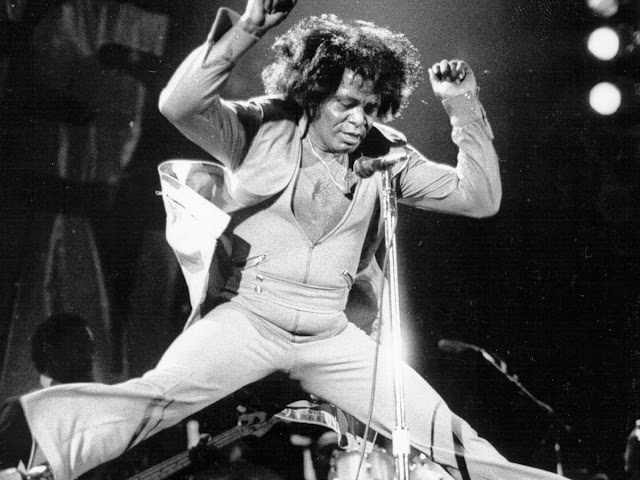
When I was young I caught a dose of the Funk. I was eight. It was 1970, a year when you could look up at the Moon and say, “there are people up there.” We were living in Ibadan, Nigeria. James Brown was coming to town. In the aftermath of a brutal civil war, Nigerians were ready to get a brand new bag on. All day long Alfred, my Yoruba friend and mentor, played ’Sex Machine’, and danced to and/or sang along with, “Stay on the scene, (get on up), like a sex machine, (get on up)”. In my teens, the Funk would strike again and again, like a persistent boyhood fever. “Ow!

        
The next time I was living in Dar-es-salaam, Tanzania. Aged 13, I’d already had my first puff of marijuana so why not resample the Funk. At the International School of Tanganyika, Kevin, a black American student hit me up with a triple whammy: Stevie Wonder’s Innervisions, Earth, Wind and Fire’s Gratitude, and the Jackson 5’s Dancing Machine. Sure, this was mainstream black music, tamed by white sensitivities, but it had something of the Funk to it, and a whole lotta soul. Kool and the Gang’s ‘Spirit of the Boogie’, mind you, was pure Funk. I felt it in my groin. “Cause when the boogie come to get you / You ain't got nowhere to go“. From then on I couldn’t control my dancing feet. The best discos at the Yacht Club were the ones where the Funk got top billing. I’d hear Van McCoy’s ‘The Hustle’, War’s ‘Low Rider’, George McCrea’s ‘I Get Lifted’, or David Bowie’s ‘Fame’ and get all loose and funky like a bowlegged monkey to the beats. White boys can dance.
        In 1978 the fullness of the Funk finally found its way into my ear. Trapped in Tananarive, the capital of Madagascar, for a week on my way home from boarding school in Fort Dauphin, I hung out at a clubhouse run by the Marines who guarded the US Embassy. It had a bar, a pool table, and a high-end stereo. Marines are dedicated followers of the Funk, I’d soon find out. I heard Parliament, Bootsy Collins, and Funkadelic, whose song 'Maggot Brain' was a trip, perfectly in sync with a marijuana joint. One Marine could twirl a pool cue in time to ‘One Nation Under A Groove’.
        Talking Heads’ Remain In Light, released the year I repatriated, was a turning point in the Funk, and in my own musical journey. My family record collection included Shakara, an album by Fela Kuti that is credited with being an essential influence on Remain in Light. Raised on African polyrhythms, I could relate to that ethno-funk more than I could my home and native land. When I heard to the album’s hit song, ‘Once In A Lifetime’ for the first time, I was surprised, elated and grateful. It was as if Talking Heads had heard the quarrel between my heart and head and turned it into music.

        
It begins with a sonic boom, a blow to the solar plexus — drum, bass, and synth fused into one explosive note — then takes off on a fiery trajectory, driven by looping grooves, an odd time signature, and a myriad of instruments, arranged by producer Brian Eno into an exquisite confusion, like an open market in Ibadan.
        ‘Once In A Lifetime’ confronted me. “And you may ask yourself, "Well... how did I get here?” sings David Byrne, who later said the song was about the unconscious: "We operate half-awake or on autopilot and end up, whatever, with a house and family and job and everything else, and we haven't really stopped to ask ourselves, 'How did I get here?'" That certainly was the burning question in my mind at the time. How the funk did I end up feeling like a foreigner in my own country, searching for an identity? Living in the gloomy metropolis of Toronto only intensified that culture shock. But my dissonance could always be soothed by the Funk. 


        Not until it all got rolled into one delicious funk-cicle did I stand up and finally pay full attention to the Funk, tho. The year was 1985. I'd just dropped out of university and was on a year-long westward trek from British Columbia to England (though, at the time, I was oblivious to my journey's end). As
 before, I hung out at the Marine House. One night a funk-loving Grunt put on Prince’s Purple Rain. Raised on a diet of rock and soul, I immediately recognized the bold and brilliant act of crossover that this new, fresh funk-rock signified, and I danced my ass off to that jam. The Funk would never be the same again.


Saturday, April 3, 2021

Cross Culture Odyssey: Memoir of a Repat - Prelude


“Do you suppose that you alone have had this experience? Are you surprised, as if it were a novelty, that after such long travel and so many changes of scene you have not been able to shake off the gloom and heaviness of your mind? You need a change of soul rather than a change of climate.”
— Seneca


My passport is my most valued possession. I keep it close to hand, like a sidearm or a manifesto for a revolution that I have sworn to bring about. It is packed with security features: holograms, complex graphics and indecipherable cryptograms. It bears some clues to my identity, not just my identifying features but my actual identity. Imprinted into the pages of that thin book, in faded ink, are all the dates and places that pinpoint my life story. It has been scrutinized, and sometimes confiscated by corrupt border officials. Oddly, I identify more with failed states than I do my own passport country, whose good standing in the international community has eased my passage across the globe. I could not care less about citizenship and nationalism. First and foremost I am an Earthling. Second, I am a global nomad. Freedom of movement across the planet is what I care most about, it is the most precious thing we can have as human beings.

They did not stamp my passport when I arrived. It seems they no longer stamp passports upon reentry. Entry stamps used to be an art form. Travellers in the 1970s were subjected to an array of clever acronyms. Best known is the SHIT stamp: Suspected Hippie In Transit. Scruffy undesirables that trailed across Southeast Asian borders would have ‘SHIT” stamped in their passports. They never stamped it in mine. While I was travelling solo through the region in the mid 1980s, two of my passports were stolen in six weeks. The authorities suspected I was selling them and put me on a watch list. I imagine they still have a dossier with my name on it. In Kampala, after drinking one too many Extra Strong Brew’s, I lost a third passport to stupidity. And on a wild and windy night on the Kenyan coast —while I slept in a four poster bed on the second floor of my friend’s ocean-front villa with the bedroom’s beveled glass doors wide open to the elements, as waves crashed against coral cliffs with a steady, fat beat, and palm fronds danced like ravers in the wind, and all that aural delirium was reverberating through my unconscious mind — a stealthy band of thieves snuck into my bedroom and made off with my MacBook Pro, my portable speaker, and a travel wallet containing US dollars and my passport. 

When I discovered the theft, I called the police. Two hours later, a pot-bellied officer and his hijab-wearing adjutant showed up to launch an investigation. They took my statement and particulars and inspected my room. They quickly deduced that the thieves had climbed up the outside wall of the house and entered from the terrace. Searching the grounds for any clues the robbers may have left behind, we followed a set of footprints to an adjacent beach. There, laying face down on the soft white sand a few feet from the surf, like a drowned migrant, was my passport. For all I knew, the cops were in on the crime and had simply dropped it there while I was not looking. Sykes monkeys might have taken it. Who cares? I had my damn passport back. 

Big boots. Small planet. Once I collected all the expired passports still in my possession and made a spreadsheet from the dates and places. By the age of 21, I had lived in seven countries on three continents and travelled more than 100,000 miles, circling the globe thrice.

Not everyone wants to travel. Some people never leave the town they were born in. Some only travel within countries that resonated with their own beliefs. These days people avoid travelling by air because of terrorism, viruses or climate change, and will travel as far as they can by rail, road, and sea instead. Psychonauts travel in their own minds. Refugees travel through no choice of their own. Migrants choose to travel and arrive just as weary. Stoics like Seneca shunned travel as a distraction from one’s self, fleeing the life one has created. Travel is not for everyone. But like it or not, we all travel. Even if we stay put, we travel. Because as it moves through space, the Earth is always in motion: rotating, wobbling, and orbiting the Sun. Your position on Earth creates a pattern in space, what I call your chrono-spatial trajectory. Even if you stay put, the planet’s motions ensure you will have a chrono-spatial trajectory, one that resembles one of those coiled telephone cords from 30 years ago. Remember when one of those got so tangled it was impossible to restore it to its original shape? That is my chrono-spatial trajectory.

My whole life I have been in orbit, spinning around the planet, unable to return home. I am like a forgotten ape aboard a rusty space capsule launched in the early years of the Rocket Age. I have been falling to Earth ever since. But every time I get close to reentry, a solar flare, or a piece of space junk, or that bone that the man-ape hurls in 2001: A Space Odyssey pushes me back up into orbit again. I may never return to Earth. Growing up in Africa and Asia during the 1960s and 70s turned me into a terminal global nomad. They say variety is the spice of life, but I have yet to find a recipe that palatably blends the disparate cultural ingredients to which I have been exposed. I am my own melting pot. And I have a backstage pass to the world.

Like my father, I am not a joiner. My allegiances are few, except to the causes of rationality, enlightenment, and truth. I have lived all over the world. Those experiences have given me rare insight into the workings of our planet. I cannot be swayed by the knee-jerk polemics of myopic people who see less than I do. I am not into alternative lifestyles. Green tea, yoga, and veganism are not going to fix my life. I am. I do not need help. I eat healthily, make ethical consumer choices, and try to keep my carbon footprint small. Globetrotting is incompatible with finicky dietary needs. Nothing offends a host like turning your nose up at their fare. Otherwise, I make my own decisions and do not allow those who I do not love to interfere.

I do not believe the planet needs me. But I need the planet, like a junky needs smack. As someone who has dropped out of three universities, lived on four continents, and had five careers, I do not fit any social profile. I once believed there would be an end to this nomadic life, that I would one day repatriate to my home and native land and be sedentarily content. Usually I am quick to adapt to a new surrounding and can fit in anywhere. So why not Canada? 

It may sound ungracious of me to bellyache about an upbringing as rich, diverse and exotic as mine. It shaped my worldview, made me a world citizen. Sure, I bounced from school to school but I still got an exceptional education. And if I could go back in time, I would not change a bit of it. OK, maybe a bit. Knowing what I know today, I might try to harbour less grief, not rebel when it serves no purpose, and stay in touch with my passport country, maintain better ties with my kin. Being a global nomad, a Cross Culture Kid, a hidden immigrant is a double-edged sword. Nothing good comes without a price. Mine is homelessness. 

This book is about my struggles with repatriation, with making a home in my homeland. It is a memoir about the uneasy transition I have faced, again and again, in returning to my passport country, and the reasons why global nomads find it so damn hard to repatriate. In transitioning to repat, after a lifetime as expat, I confront some of my poor choices, understand the reasons for them, and try to discover who I really am. My hope is that, as I begin to take some agency in my life, I will get over myself, regain my integrity and become a better man.


Download a copy of the Book Proposal

Friday, October 20, 2017

One More Spin Around the Sun


Another year, another chronospatial trajectory: 24,000 miles.

A year ago, I flew from Los Cabos to Ottawa, saw in Halloween at Liam’s house (one helluva party, nephew), then took a bus to New York City. A fortnight later, I returned to Kenya for an indefinite stay, or as long as I could get away with it. I ran a backpackers hostel out of Joe Bennie’s oceanfront villa and spent the rest of my time either at Driftwood or Fishing Club, getting tanked with the locals. I wrote a lot, too, in this drinking village with a fishing problem. 

The emotional journey was a roller coaster. When I left Cabo at the end of October I believed I was saying farewell to my father for the very last time. He’d suffered a stroke and an infection. “It’s probably the last time you’ll see me,” he said when I hugged and kissed him goodbye. “I sure as hell hope so!” he added.

A month later, I was eating focaccia at Rosada restaurant in Malindi when in walked Roberta Romeo, a Sicilian goddess of rare charm and beauty. It all happened so quickly, like Appalonia and Michael in The Godfather: “Monday, Tuesday, Wednesday; Michael, andiamo... BOOM!”

“Careful,” said Barry, when he saw the two of us together at Driftwood, “she’s Sicilian, she’ll cut your throat.”

“No,” said Roberta, flashing me a gap-toothed smile, “I smash on your face.” And so began our whirlwind romance, which lasted through the New Year until the money ran out.  Roberta returned to Sicily while I stayed on in Kenya for a bit, prevaricating about my future. But we couldn’t bear being apart and six weeks later we were reunited on Vancouver Island. We’ve been there ever since, putting down roots and building a future. Last month we got married.

I now understand how Fifties Cinema let curvy Italian brunettes like Lollobrigida and Loren steal the limelight from curvy American blondes like Munro and Mansfield. It’s all in their attitude. When my mambo-Italiano bombshell wife spouts forth her hilarious one-liners peppered with pithy Sicilian maledictions, it can sometimes feel like I’m living in a hit sitcom. Pass the pasta!

Then, in April, the money ran out. So, I decided to return to Canada.

I’ve grown up fast. I did not expect to start a whole new life in my fifties. Repatriating to my home and native land after thirty three years an émigré was in itself a stretch. It helped that just six weeks later I landed such a sweet job: fundraising for Providence Farm. It's been a while since I had a steady job. And now to start the blindingly bureaucratic procedure of sponsoring Roberta so she can freely live and work in Canada, too. Vaffanqulo!


“Am I glad to see you,” said my dad, when Roberta and I stopped by his care home on the way in from the airport. We had just arrived in Los Cabos. Though still bedridden, he’s in pretty good health. And his mind is sound. “Welcome to the family,” he told Roberta.


It’s a year to the day since I left Los Cabos. So, in a manner of speaking, I’ve made ends meet, book-ended my chronospatial trajectory. Wonder where serendipity will take me next? Hold on!