Tuesday, August 27, 2013

Jonny Gibbings' review of PIRATES

I'm not sure where to start with Greg Cummings 'Pirates', what I will say though, is it is a wonderful book. If you, like me, started out reading popular books that had a romping pace, the stuff like Robert Ludlum and Wilbur Smith and you loved the roller coaster plot, but soon got bored of them because they quickly lacked substance. So you started reading novels with more bite. Pirates has every bit the plot and pace of epic yarns but also has a unique depth and integrity, effortlessly weaving around serious issues and the politics of deepest Africa.

Pirates is the tale of a Safari guide and who happens upon his believed to be dead friend Jonny Oceans, who recruits him to help him re-enter Somalia. However things are not what they seem. The reader is taken through the Gulf of Aden, facing jihadists from Al-Qaeda and al-Shabaab, a different understanding of Somali pirates and Somalia itself. I imagine many base their view on Somalia as I do on films such as Black Hawk Down and on news footage of AK-47 toting pirates. Greg shows us proud people fighting to keep Puntland independent in the face of growing pressure from Muslim extremists, through beautiful, tight t-shirt wearing, skinny jeans loving matriarch Kahdija. Where Pirates excels is that it uses real issues as plot points, not the plot itself. Greg has so many plot points that fragment, leaving you in suspense as you just know they are in a funnel and will all meet at a singular event. While there is real tension, and real issues, the story is all adventure and drama with some brilliantly funny parts. There are some far-fetched elements that are Indiana Jones over the top, such as the Vulture/drone bit, but you don't mind, simply as it is infused with such reality and drama that it balances it out. The story builds and builds to such a fantastic end once you have read through twist after twist. With US Navy drones, CIA Spy's, treasure, kidnap gunfights and romance. This is a brave book and Greg pulls it off, the result is simply staggering and a truly epic read.


Follow the buzz at Pirate Yarns: http://pirateyarns.blogspot.com

Jonny Gibbings is the author of 'Malice in Blunderland' (Cutting Edge Press) and you can follow his blog here.

Tuesday, July 16, 2013

The Dark Side of the Earth

As the high-fidelity stereo arm gently touched down on the turntable, a diamond needle began tracking across a mint vinyl pressing. Wearing a pair of headphones bigger than my head, I heard a warmly pleasing sound: flawless, crystalline, entirely new to my ears. 

At first there was only a heartbeat, which I mistook to be my own it was so clear, then a voice followed by more voices, reverberating machinery, and a screaming that rose to a crescendo until suddenly one goodly chord rang out. And a young man sang, “Breathe, breathe in the air. Don’t be afraid to care…”

The record sleeve didn’t say much. Apart from a few liner notes, there wasn’t anything to look at, no photograph of the band, just a beam of light shining through a prism set against a plain black background. 

I couldn’t put it down. And over the next three quarters of an hour a medley of clever, bluesy tunes, each one about the lack of empathy in the modern world, kept me entranced. I was fourteen years old.


“Of minor significance was the simple, elegant layout against black. Standard textbook illustrations did not do this. Of greater significance was the art direction, or rather the fortuitous decision to listen to Rick Wright, who suggested we do something clean, elegant and graphic, not photographic - not a figurative picture. And then to connect this idea to their live show, which was famous for its lighting, and subsequently to connect it to ambition and madness, themes Roger was exploring in the lyrics...hence the prism, the triangle and the pyramids. It all connects, somehow, somewhere.”
Storm Thorgerson on the design of The Dark Side Of The Moon


On April 18th, after a long struggle with cancer, British graphic designer Storm Thorgerson died. He was 69. With his passing the world lost one of it’s most creative artists, the music business lost its best album designer, and I lost a friend. 

In a career spanning five decades he created over 300 album covers and imagined the dreams of a generation. He plumbed the psychic depths of rock and roll with weird runic pictographs and montages, images that became animated in our minds. He left a legacy we can pour over in solitude, two dimensional sculptures to hold and admire while the music they interpret fills our ears. 

His work with Pink Floyd, for which he’ll likely be best remembered, often involved conceiving and photographing elaborate ‘events’ that had been extrapolated from a single lyric on the record. 

Among his best work by his own reckoning is the design for Wish You Were Here, shot on location in California. It explores the abstraction of absence, a concept he returned to again in later designs. 

But now as I study his art I see only absence, of the extraordinary person with whom I had the good fortune of collaborating and forging an enduring friendship, and the artist who blew all our minds with graphic designs.


Don’t Walk Away Rene

Album artwork opened a door to great music for me. As a teenager growing up in Africa during the 1970s, I largely missed out on popular culture. LPs were hard to come by in socialist Dar-es-Salaam. There was just one record shop, a dusty, desolate downtown establishment owned by a wiry Indian merchant who stocked only Bollywood soundtracks. 

Occasionally he’d stock Top of the Pops compilations. These turned out to be fraudulent. The scantily-clad dolly-bird on the cover, done up like a bag of chips,  should have been warning enough. Inside was collection of songs by anonymous acts that mimicked the original hits. So instead of ‘Ballroom Blitz’ by The Sweet or ‘Son of My Father’ by Chicory Tip you got an imitation of a song that was not particularly good to begin with. This was teenage hell.


Not before I returned to Montreal on home leave did I get to hear the greats as they were meant to be heard, on my cousin’s high-end stereo. He had converted his basement into a progressive rock cave, painting the walls black and plastering them with dark posters of long-haired brooding rock bands. “Here, check this out,” he said, placing a pair of headphones on my head. And so it began.

That’s how I discovered Hipgnosis, who were credited with designing most of the albums I liked. Accordingly I picked up a copy of ‘Walk Away René’: The Work of Hipgnosis (Paper Tiger, 1978), an illustrated coffee-table book of their creations from the previous decade. The company was a collaboration between art school film graduates Aubrey ‘Po’ Powell, Peter Christopherson, and Storm Thorgerson. Before you knew it I was a Hipgnosis groupie.


The Eye of the Storm

“When asked what I personally do I reply in a variety of ways. For Her Majesty’s Customs I am a photographer. For the music press - a graphic designer. For film people I’m a director. For my mother an artist! For my loved ones, a pain in the butt. Sarcastic musicians see me as an organising ponce who doesn’t do much actual work. True believers, i.e. employees, however, know I make images. I think of ideas, often in collaboration, and turn them into tangible visuals, be they still photographs or movies.” 
- Storm Thorgerson, Mind Over Matter

After Hipgnosis disbanded, Storm Thorgerson continued working solo from a studio in Belsize Park. With the advent of the compact disc the music business had gone through a dramatic transformation. The switch from vinyl required a shrinkage in packaging. Record companies were no longer prepared to throw money at an album’s design and gone were the days of expensive location shoots in Morocco and doing things by hand. Still, there were plenty of back catalogues that needed repackaging.

Pink Floyd remained Storm’s main client, though they hadn’t given him any new work in a decade. What reason did they have to record anything new with the royalties they were earning? The Dark Side of the Moon had become a ‘platinum monster’ spending over 700 weeks at the top of the Billboard charts.  

Thereafter the Floyd entered a super league. But with success behind them, the band members soon lost sight of why they had started playing tunes in the first place. This darkened their outlook and contributed to the bitter departure of bassist Roger Waters in 1986, as prophesied in his lyric fourteen years earlier: “And if the band you’re in starts playing different tunes, I’ll see you on the dark side of the Moon.

Such was their inertia that whole generations passed between the Floyd’s trips to the studio. All those connected to the band, the so-called Cambridge Mafia who had been caught up in the eye of this phenomenal rock and roll storm since school days, soon starved. 

Although his designs contributed in no small way to the Floyd’s success, Storm was only ever paid a fee for his work on their albums. This caused some resentment, which he cheerily alludes to in his book Mind Over Matter (Sanctuary Publishing, 1997): 

Back in the mists of time, shortly after the release of The Dark Side of the Moon, Steve O’Rourke, fabled Floyd manager and Clark Kent lookalike, was walking down London’s fashionable Bond Street in a cheery mood. He put his arm around my shoulder and pointed out an expensive looking sports car and asked me why didn’t I have one of those. He knew of designers in LA who did, he added. I answered that I didn’t earn enough money. Come off it, he said. I might, I ventured tentatively, if the Floyd would pay me more - not that I’m complaining. He withdrew his arm. Not a chance, he said, and changed the subject. Bye bye sports car.”


Between Apes and Angels

“I don’t know many Hipgnosis groupies,” said Storm Thorgerson, tucking into his lamb shank. 

“You opened the door,” I said. “Back when I was building my record collection ‘Designed by Hipgnosis’ was my only hallmark.”

"You're too kind," said Storm. 

It was a sunny October afternoon in 1994 and I was lunching at Primates restaurant in Chalk Farm with my childhood hero. Our meeting was as a result of a science documentary Storm had produced for Equinox,The Rubber Universe, examining the Hubble constant. After watching it I'd contacted the production company who then put me in touch with him. 

“I don’t believe in charity,” said Storm. He wore a fixed expression of disinterest, which I soon discovered concealed a well of humanity. “If the gorillas need saving then it’s up to governments to pay for it. That’s why I pay taxes. Still, I am intrigued. Tell me more about this film you want me to make.” 


The year had begun well for the gorillas. Three years into a dazzling new career as executive director of the Dian Fossey Gorilla Fund, where my wife Jillian was also a director, I was optimistic. We had started from scratch, promoting an obscure cause in a far-flung place, but the future looked bright. Our positions opened many doors, and we took advantage of every chance we got to promote the gorillas.

NASA, the American space agency, having reneged on an earlier agreement, had just confirmed it was reinstating us to its Mission to Planet Earth. Two flights of the space shuttle Endeavour, STS-59 and STS-64 scheduled for April and August were to use a highly sophisticated spacebourne imaging radar to obtain data of the planet’s environmental hot spots, including the gorilla habitat in central Africa. 

Then one night in January, as the lights came up in Ronnie Scott’s jazz club, I spotted ape actor Peter Elliot in the audience and went over to say hello. Peter was the first to hear about any ape movies in the studio pipelines. “Just the man I want to see,” he said, with a high-pitched, gravelly cockney lilt. “Paramount Pictures is making a movie of Michael Crichton’s book Congo. You need to get in touch with Sam Mercer.”

The next day I bought a copy of Congo and started reading it. I couldn’t believe the serendipity. Crichton’s story incorporated high-tech space imagery of central Africa’s gorilla habitats. Wasting no time, I let Paramount know about the planned shuttle missions. 

“The studio executives love the idea of using your radar images in their movie,” said Mercer when he called back the next day, “because they want authentic and are willing to pay your organisation $10,000 for the privilege.” 

By Hollywood standards this was chump change, but considering NASA’s images would end up in the public domain, it seemed a pretty good offer at the time.

At the end of March, just days before STS-59 was due to launch, Jillian and I flew from London to New Jersey to meet Scott Madry, head of the Remote Sensing Centre at Rutgers University, who had first thought of using spacebourne radar to penetrate misty gorilla habitats. Hollywood's Mike Backes, a Congo producer, flew in solely to join our meeting, as did the heads of our conservation project in Africa. 

Each of us was keen to capitalize on the publicity that two space shuttle missions and a new feature-length movie would bring to the gorillas. We had no idea about what was about to go down, in a ball of flames.


At the time few people had even heard of the green and hilly landlocked nation wherein we carried out our work protecting mountain gorillas. Even I’d seldom heard the place mentioned while growing up in Africa. Cartographers were never sure how to spell it. ‘Ruanda-Urundi’ as it was known during German colonial rule would sometimes turn up on modern maps. That it was the setting for Gorillas in the Mist was the extent of most people’s knowledge of Rwanda.

All that changed on April 6th 1994 after the Rwandan president’s plane got shot down and the country quickly descended into bloody anarchy. In an effort to wipe out an entire ethnic group, for the next hundred days bloodthirsty vigilante groups hacked to death hundreds of thousands of innocent men, women and children, in what became known as the Rwandan Genocide.

We feared the worst when we were unable to reach wildlife veterinarian Dr Louis Nzeyimana, who was trapped in Kigali with his wife and seven month-old baby. For the first few days we remained completely powerless. 

Meanwhile the space shuttle Endeavour was in orbit, doing what it was sent up to do, scanning the gorilla habitat. Astronaut Rich Clifford who was on board at the time recalls the operation. “Radar imagery of the gorilla enclave in Rwanda during the STS-59 mission proved the value of the Spaceborne Imaging Radar... Visual observations of the enclave during the mission were usually obscured by clouds or darkness. The imaging radar could ‘see’ through the obscuration and thus valuable information was obtained.” 

Although undetectable from space, and invisible in the resulting images, Endeavour’s radar could also ‘see’ the killing fields of Rwanda, where one of the most horrifying acts in human history was unfolding. Consequently NASA refused to give us the data fearing they may be accused of spying.  

Suddenly our little organisation was in the wrong place at the wrong time, trying to promote an obscure cause which seemed inappropriate during such a time for Rwandans. Gorilla conservationists argued that as incongruous as they may seem in the midst of war and genocide, these large charismatic mammals could one day be a boon to the effort to rebuild this country. And they were right.

It was one of the lowest points in my career. Often during office hours I would head to the local pub in the afternoon and start downing whiskeys. 

But my dramas were of no account compared to the human suffering in Rwanda. On the Friday morning after the bloodshed began, Louis Nzeyimana finally reached me by phone from the hotel Mille Collines (later immortalised in the movie Hotel Rwanda). 

“I’m taking my family,” he said, voice quivering as he struggled with his English, “and we are fleeing Kigali today in the 4x4 vehicle.”

“Where will you go?” I asked.

“To Goma,” he replied, “in Zaire, where hopefully we can get on a plane to Nairobi.”

“Listen," I said. "There’s an eight-week conservation education course starting in the Cotswolds next month. I’ll enroll you and hopefully that will enable all three of you to get UK visas.” 

It seemed an impossible journey, along a road littered with dead bodies and barricaded with more than sixty road blocks manned by murder-drunk vigilantes. Louis was from the right tribe but his wife was not, though her papers stated otherwise. And although she was uncharacteristically petit, his tallness made him suspect to pig-ignorant vigilantes. At times it was only the gorilla logo on the side of the charity’s car that saved them, provoking cheers of solidarity from genociders who then allowed them to pass. 

It took them ten hours to drive 200 kilometres. They crossed the border at 6 o’clock arriving at Goma International Airport barely in time to make the last flight out. 

I called the British High Commission in Nairobi and convinced them to issue Louis and his family visas on a Saturday, which kept immigration off their backs when they arrived at Heathrow the following morning. I’ll never forget the look of utter release on the Nzeyimanas' faces as they pushed through the gates. They lived with us for the next month in our small council flat in north London, and I never once saw her put that baby down. They never returned to Rwanda. 

Meanwhile gorilla patron Arthur C. Clarke was urging the American space agency to hand over the habitat radar data, saying, “I’m sure if this information is released properly, it will bring the best possible publicity to Nasa.” 

NASA wrote back, “We are happy to report that data were successfully acquired on two passes over the site, on Orbit 58 and Orbit 171. Images have been processes at JPL for the first data take and will be transmitted to the research team at Rutgers for analysis… We look forward to attempting to image the Karisoke site on our second flight in August.”

~~~

“You mean you’ve never seen the Floyd in concert?” asked Storm, with perfect nonchalance. It was Saturday afternoon, the day after our lunch at Primates, and he had called me at home.

“No, never,” I replied.

“Tonight’s their last performance at Earl’s Court,” he said. “There’ll be an access all areas pass waiting for you at the door.” 

I gasped. I had just been invited to the inner sanctum of a rock phenomenon that famously walled itself off from its fans. My excitement grew as I rode the Tube into town and a cascade of images from the band’s discography came to mind: a cow standing in the English countryside / a man diving into water without causing a ripple / rays of light / cathedrals / a floating pig / balls / coins / ticking clocks - every one a Storm Thorgerson invention.

Kensington High Street, one stop before my destination, where the band’s loyal following began in 1965 after they performed at the Countdown Club. An obscure sometimes frightening manifestation of the new psychedelic culture, the Floyd would play until dawn, set after set of eccentric rhythm and blues songs extended with lengthy solos and accompanied by mind-blowing light shows. 

While fame did not grow overnight a seed was certainly sewn, or rather a magic bean, for when it did appear it was colossal. To date the Pink Floyd have sold more than 250 million records worldwide.


Expecting the clouds to part, I gazed upward as I emerged from the Underground. Masses of people were queuing outside the venue. After a record thirteen nights at Earls Court tickets were a premium for this final performance of one of rock’s most monumental acts. 

Eventually I located the stage door where I was meant to pick up my pass and stood in line with Mike Rutherford, the bassist from Genesis. Smiling, I said, “Loved your album Smallcreep’s Day.” He smiled back.

Uncertain what an AAA pass meant at first, I quickly discovered I could to go absolutely anywhere. Soon I was backstage watching a roadie hand spool a 70 millimetre film to be back-projected onto a giant circular screen behind the band on stage, for ‘Shine On You Crazy Diamond’.  

After a whole set of greats, the band broke for intermission. I wandered around the vast venue holding a plastic pint glass full of lager and whenever the whim took me, swanned through barricades manned by surly bouncers who never so much as batted an eyelid at me. I was astounded by the number of eighteen-wheeler trucks parked indoors behind the stage. 

Then I heard it - a heartbeat followed by voices, machinery - and I hurried back. An unexpected treat: for the first time in many years Pink Floyd was performing The Dark Side Of The Moon in its entirety. 

Storm had decamped to the mixing desk with the rest of the Cambridge Mafia, but I spent the duration of the concert riveted to the stage, standing amidst fifty thousand enthralled fans, transfixed by Rock’s supreme son et lumière. I had been waiting for this moment for twenty years. And I got to tell this to the band in person after the show. ("C'mon it's time to go...")

~~~

“What’s the point of having a dream team if you’re not prepared to fucking listen to them?” scoffed Storm. It was the following Spring and we were making a short film together, a goodwill message from Arthur C. Clarke to be shown at the London premiere of Congo. It wasn’t the film I had originally envisioned Storm making, but there wasn’t any money for that.

With Clarke’s greeting from Sri Lanka in the can, he now wanted to shoot a closeup of the author’s books but I objected to the additional cost. Storm did not back down. After thirty years of explaining his vision to music industry morons, he was hardly going to yield to a neophyte like me. Moreover he was my hero. “Alright!” I said, “we’ll do it your way.”

The next morning, I carted a stack of science fiction paperbacks down to King Studios in Soho and found him at the controls of a 35 millimetre rostrum camera, which had been designed to animate still objects. Silently, between sips of tea, he arranged the books on a table beneath the camera, then rolled the film and slowly panned the books. Moving diagonally and capturing every tear and dog-eared corner, he told an unexpected story, different than what was written in the books, or I had envisaged. It was freaking alchemy.

We became good friends. His studio in Belsize Park was a mere ten-minute walk from my office, and I’d often visit and watch him work. I loved listening to his stories and found his mordant sense of humour an antidote to the terrible things that were happening in my life. He shone a light.


My chance to return the favour came on New Year’s Day 2001. Storm was writing a book called ‘The Book of Black Things’ and wanted Arthur C. Clarke to write the forward. Arthur was in London on a rare visit to Britain. He'd come for a special screening of 2001: A Space Odyssey at the National Film Theatre, a new 70mm print with digitally remastered sound.  

After the screening we were invited to meet Arthur at Brown’s Hotel in Mayfair. He wasn't feeling too energetic and chose to receive us upstairs in his suite. Brother Fred ushered us into the room. There beneath plush covers, a stack of satin pillows propped up behind his magnificent bespectacled head, was the world’s greatest futurist, cracking asides with pinch-me-I’m-famous incredulity. 

“I feel as though there should be a monolith in the room,” quipped Arthur with his arm outstretched, aping the rapidly ageing Dave Bowman in the penultimate scene of 2001.


Arthur agreed to Storm’s request for a forward, though in the end ‘The Book of Black Things’ was never published.


Subject: Re: jungle love

hi greg

my my its you
didnt know you'd left gorillaville
but not before time i guess

uganda?
why uganda?

glad to hear about writing...keep at it
if it were easy everybody would do it

my life has been plagued with illness
first the stroke rendered me disabled
then...
a barrel of laughs to be sure

take care
storm


With Storm’s passing there remains only absence, a sustained chord searching for accompaniment, as palpable as his creations, the perplexing album sleeves he designed, the superfantastic films he made, the larger-than-rock events he staged, from Marrakech to Battersea, proving pigs can fly. 

He was a pillar of strength to me when the temple came tumbling down around me. He understood that there is a dark side to everything but that it’s not all dark. 

Shine on Storm!


Friday, July 12, 2013

The Blinding Geezer from Carlisle


Looking back, I can now make sense of that bleak semester I spent alone at the Quarry in Surrey. The previous six months I had witnessed a military coup in Thailand, famine in Ethiopia, and been arrested for espionage in the Yemen. The 17th century cottage on the estate of Lady Bronwen Astor proved the perfect sanctuary. 

I’d been almost everywhere yet belonged nowhere. Born in an affluent North American city, shortly thereafter I was dragged off to live in hot, difficult places. This made me an outsider, a ‘reverse-refugee’. The move to England was meant to straighten me out. But shell-shocked, disorientated, and in low orbit around London, I seemed incapable of kick-starting that career in journalism.

One blustery night in May, on the eve of my twenty fourth birthday, I was in my room listening to the wireless. Storm clouds were gathering and the treetops teetered back and forth. The antique wooden writing desk opposite my bed, its bevelled top slid open to reveal an untidy array of handwritten notes and unfinished stories, and my Canon Typemate portable electronic typewriter were all covered in a layer of dust.

I was studying the world map on my wall, searching the continents between the Tropics for somewhere warm and exciting to go next, when the door bell rang. A visitor, now?

I hurried down the stairs to the front door and opened it. There stood a wiry young man, his face covered in self-styled anarchic tattoos. “Hiya,” he said grinning. “I’m Andrew. I’ll be staying for the week.”

I scratched my head. “Ah, Andrew. Lady Astor said you might be coming, but I wasn’t expecting you for a couple more days.”

“Well here I am. Fancy a pint?” Looking up at sky I wondered if the idea might be a bit rash, but he insisted. “I‘d really like to celebrate. It’s my first night out of prison.”

I grabbed my coat and an umbrella and we headed to the nearest pub. The look in his eyes as he tasted his first glass of Chippington’s is still fresh in my mind. He couldn’t say enough about how good it felt to be free.

Andy was a kindred spirit, another lost soul confined to the periphery of society. Our paths could not have been more disparate - his eighteen month in prison for assault and car theft began about the same the time I dropped out of university to conquer the world - but now they had crossed, at the gates to the asylum.

“Her ladyship asked me what I wanted to do with my life,” he said, eyes darting around the pub. “What sort a question is that for a twenty year old Guilford punk from Carlisle, just out of prison? I’m happy if I get a job as a street sweeper and somet better than a squat to kip in.”

We shot a few games of pool, sized up the talent, then headed back to the Quarry. On the way home I let slip my birthday was tomorrow. “Blinding!” he said. “I’ll bake you a cake.”

The next morning I found him in the kitchen whipping up the icing. He had already baked a dozen cup cakes and prepared as many sandwiches. “I hate the bloody Queen!” he said, frantically beating the bowl. “I mean, why should she have two birthdays, eh? Why not one, like with everybody else in the world, you know.”

I was touched. Someone I hardly knew putting all this care and attention into celebrating my birthday. “I’m throwing you a party. Already invited some people. We’ll need supplies.”

In town we picked up a litre each of whisky, vodka. and scotsmac. Andy tried to score some gear from an old mate, offering him an invitation to our party as payment, but the geezer said he had a wife and kid to think about now. In the end only Sister Andrew dropped by the Quarry, briefly for a nip of whisky and a piece of cake.

As the night progressed Andy acted out stories from his ‘jack up days’ in Guildford. “I was living with Sharon, beautiful Sharon, hooked on smack and fixing in squat toilets. I remember her shuddering in my arms like a kitten. I brought my hand back to give her a slap, like. But it was too hard. I couldn’t hurt a girl like that. It was like she wanted me to hate her, you know.”

We talked until dawn when I bid him good night. It was the last I ever saw of him. Later I was awakened by the police. Lady Astor’s BMW had been stolen. They found it wrapped around a tree a few miles away. And Andy was on the run.

Bronwen blamed me, said I must have encouraged him. I was heartbroken. Why hadn’t the blinding geezer from Carlisle asked me to come with him?

Sunday, April 7, 2013

A terrifying trip through the heart of Africa


This in-depth review of GORILLALAND, written by Lisa Niver Rajna was published September 2012, Technorati website

Greg Cumming’s Gorillaland describes a compelling and
terrifying trip through the heart of Africa. The reader is treated to a cast of characters like individual strings in a Byzantine intrigue, from the pristine to the corrupt, to the archetypal and historical. When each is tightened into place and woven more completely together the story's tapestry reveals the chaos, greed, natural beauty and power of Earth's largest continent.

While following the story of minerals like diamonds and coltan, Cummings work exhibits a remarkable level of understanding of the issues. Richard Katz, the “Jewish” Diamond King from South Africa to New York, Natalie, the up and coming young NGO executive from WorldWatch, Derek, the rebel cowboy guide complete with boots are like Broadway Musical stars waiting for their solo to share their side of the story. Their arguments with each other pale when they become entangled with the rebel general and warlord Cosmo Zomba wa Zomba who has killed not hundreds, as the International Criminal Court in the Hague says, but thousands. Nearly all the characters are chasing the chance to restore the honor of a family member, an opportunity for bloodline healing. Lions are not the only predators in this story; crocs, revenge, and the past all come back to bite you in this story.

The setting of this story is the Congo, “The place is fantastical, with all its erupting volcanoes, exploding lakes, impenetrable jungles and, of course, the river. Add human suffering to the mix and you have the perfect setting for a movie.” The issues of saving silverback gorillas, who are being hunted as food and for witchcraft rituals, as well as the drama of how to remove resources from the Earth and what constitutes fair trade are enough for a blockbuster. But add in centuries of African struggle and conflict of religion, culture and the story really takes off. The additional issues of international aid from foreign countries, corruption in the military, and various feuds, boils this story into a cauldron that must erupt nearly as certainly as the possible explosion of Lake Kivu!

The anecdotes and life stories of the main characters explain the hardship and devastation of this vast land. Using the characters' personal histories as context ..... Pedro’s loss of his entire Rwandan family living in Uganda due to the ravages of AIDS. The reader learns without feeling lectured. The "Lost Boys" tragedy of being torn from family or watching them suffer reveal how this army of young soldiers has been twisted into place. The ever present and lovely-looking yet nefarious Madame Nshuti, with a curious scar under her wig, a poorly ended affair with Derek, shows this Michele Obama of the Kivu to be a survivor but is she also a killer, and double crosser?

Natalie’s evolution is apparent when she yells at Cosmo while in the jungle, “You don’t frighten me. You disgust me. You think you rule the Congo? You don’t. When the real rain of progress falls on this country, murderers like you and Duke will simply melt away in the jungle, never to be seen again.” Many of the characters are forced to reconsider their life-long attitudes of hate to others especially Duke, who “was sworn to hate the Hamites.” Yet after interactions with Pedro, a Tutsi, he must alter his thoughts.

The moments for key players to cross and double-cross each other with arms deals, mineral wealth and loss of life seems to the reader like watching a tennis match. Which side is winning? Will evil overtake all? Just when you think you know what will happen next, some natural disaster like looming lava or great earthquakes disrupt all especially those on the river in their iroko pirogues.

In our technically-evolved world, we forget that nations have found ways to speak to each other. “Hakuna raisaux,’ said a Mai Mai soldier wearing the mane of a bush pig on his head, ‘we have no (cell) network here, but you can drum him a message, and it will reach that side now-now. I speak Balanga drum.” From far away, it is hard to understand or even imagine the jungle world of the Congo; this story brings light to so many critical elements of Africa that we should learn to understand.

Derek sums it up at one point, “You have to hand it to the Congalese for remaining so optimistic in the face of such adversity. I mean, these people have nothing: no government, no institutions, no infrastructure, nothing. Yet they still have a touching belief that great things will happen in Congo.”


Lisa Niver Rajna, Greg Cummings and Richard
Bangs pose with the Caped Crusader in Bel Air
On a personal note, I met the author, Greg Cummings, at a private screening in Bel Air. His astonishing first-hand knowledge of Africa, the gorillas and all the players in the madhouse of the jungle make this moving story very real. I know that his efforts to improve mining conditions and also help the gorillas have made for some of the best on-the-ground advocacy from the region. My elementary school students and I were fortunate to have him come and share his passionate intensity with us. We look forward to being part of the grassroots solution with creating more gorilla-friendly electronic devices, like cell phones and computers. Perhaps we can help to save this unique animal and even learn how to save ourselves.


Gorillaland by Greg Cummings is available as an ebook and hardback at Amazon

Friday, March 29, 2013

Cosmo's Journey Down the Lomami River


Excerpt from Gorillaland (Cutting Edge Press, London 2012) by Greg Cummings

Cosmo had spent the night following a surreptitious path westward across the jungle, down the gradual incline that separates the tributaries of the Lomami from those of the Congo, past innumerable trees bearing baleful warnings, carved into their trunks or hanging from their branches, and through death’s other kingdom. He’d walked for the whole of the night without rest and, as the sun rose above the trees, he was sweating through his beret, and his eyes were like molten lava rocks behind his glasses. Despite the discomfort, he wore his thick camouflage jacket bearing the blood-red mark of Mani Kongo. 
When the bazungu first passed this way a hundred years ago, they believed they were discoving somewhere no civilised person had ever seen before. And yet beneath their boots were the ruins of two great African kingdoms. Over hundreds of years the kingdoms of Kongo and Lunda had flourished, controlling the mineral trade in and out of the Congo, and even sending ambassadors to the Vatican. In time they succumbed to mercenaries, slavers and foreign plundering, and had now all but disappeared. That was centuries before Livingstone and Stanley ever set foot here, yet they called themselves ‘explorers’. Africa was littered with the tombstones of bazungu who never bothered to take the time to learn about the place. Cosmo stopped to behold a watercourse beyond the trees and smiled. At last he had reached the banks of the Lomami River.
The longitudinal Lomami was a very different kind of river than those that usually flowed through the Congo Basin. On first inspection it bore no sign of sentient life whatsoever, yet it had once been a main navigation route, connecting the south of the country to the Congo River. Over the centuries, and right up to the present day, the Lomami had witnessed some of the most horrific acts of inhumanity anywhere. More than any other watercourse, it harboured the tormented souls from Congo’s bloody history, and it had always been the last line of Cosmo’s defence.
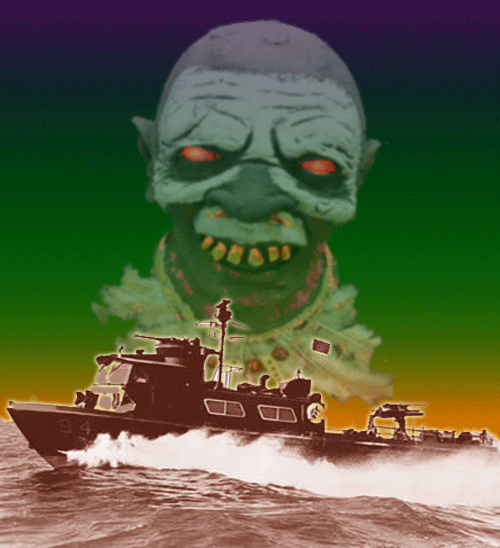
His prize possession was exactly where he’d left it six months previously, fully armed and ready to go: a fifty-foot, aluminium-hulled Swift Boat. If there was one good thing about the Left Bank, it was that you could always leave your hardware unattended and no one would dare touch it. He climbed aboard, pulled the fallen branches and vines from the deck, as well as the handful of evil totems he’d scattered across the bow to ward off any brave intruders, and untied the boat from its berth. It was the same iroko tree to which the boat had had always been tied. When Cosmo bought it off General Kiko five years earlier, he found it moored to this tree on the riverbank. A decade before that when Kiko first stumbled across it, he too found the Swift Boat tied up in the same place in the jungle. No one knew its origin, but one thing was for certain, the boat was unfailingly river-ready, and provided the fastest possible way out of the jungle.
A few years back he’d replaced the old engines with twin 580-horsepower Detroit Diesels, and the eighty-one-millimetre gun at the rear with a cupola-mounted MK19 machine gun. What else did he have to spend his money on? He now checked that the grenade ammunition was still in the hold. It was there, along the ammo for the rear machine guns. After turning over the engine a couple of times without ignition, he checked the battery connection, then tried again, and it coughed and sputtered, but eventually started. Cosmo eased the boat away from the bank and headed north down the brown Lomami River in the direction of Opala, which at a speed of twenty knots, with a five-knot current, it would take him the rest of the day to reach. 


As the Swift Boat arced around a bend, the river appeared tranquil and barren. Cosmo knew otherwise and almost instinctively observed every symbol and sign that had been scratched in the trees, or arranged with stones on the riverbanks, left there by those who had preceded him along the deadly Lomami. Some warned of rebels and mercenaries, others of evil spirits, and places to be avoided at all costs. Cosmo did not fear the supernatural, though he respected it. The power of muti was strong and he sought to make use of its forces for his own practical purposes. He rarely consulted witch doctors, believing he already possessed all their talents and more and, though he had marshalled the power of muti often, black magic was just another arrow in Cosmo’s quiver. He had learned how best to administer fear as a means to an end and didn’t let the muti haunt him like it did so many other warriors lurking in the shadows of the Left Bank.

Nudging down against the tree line, the sun was yet stoking the afternoon heat, while the air hung still and sticky on the river. Cosmo slowed the engines right down, as his Swift Boat approached Opala, gradually and silently drifting up to the village dock: a few sticks in the mud on the riverbank, strewn with tattered fishing nets. Except for a single, piercing, monotonous cicada song, there was no sign of life. The village appeared to have been abandoned in haste, with utensils, tools and root vegetables still out on empty stalls. Cosmo was on his guard, knowing he was probably being watched by unseen eyes in the forest. People in this part of the jungle were known to leave their valuables lying around by the riverside, unattended, to lure people ashore, while they lurked in the dark. When a visitor laid a hand on any of it, they were caught, flayed alive, and added to the local food chain.

Cosmo had seen things at the back of Opala’s upright mud and thatch huts to make his steely blood curdle: ghastly instruments of muti that should have been buried long ago. Hidden in wooden boxes in that unholy ground behind the lattice bamboo fencing, amid the grim fetishes and rotting peculiarities, dwelled the horror many had written about but few ever saw. It was back there, locked away, if anyone dared look: a mirror for the dark recesses of the soul. 

An old palm tree bent over the river provided a mooring for the boat, and Cosmo advanced cautiously through the village, trying not to disturb anything. He had his Glock in one hand and, held high in the other, a live grenade with its arm taped down, to let whoever was watching know he meant business. As he approached the shadows behind the village, away from the riverbank, the air became rife with the smell of death and decay, and he began to see evidence of their grotesque carnivorous appetites. Bleached white human skulls ornamented the streets, while a multitude of thighbones and ribs lay piled in a rubbish pit behind the cluster of huts. Scraps of palm nuts, bananas, sugar cane and cassava at least testified to a varied diet. Then from somewhere nearby he heard the sound of a log drum, tapped in slow succession: tuc dun, tuc dun, tuc dun. Cosmo understood it to mean ‘welcome’, so he worked the pin back into his grenade and holstered his pistol, then continued into the forest, guided by the sound of the two-tone drum.

As the gloom of the jungle encircled him, he was compelled to remove his shades to find his way through the thick entanglement of thorns and stinging nettles. Every few metres, planted atop a stake in the ground, was a grinning skull, some human, some ape, with many more in the mud bearing only their remains. Then he came to a passageway some twenty metres long, which he had no choice but to stoop and enter, or else turn back. It was an indestructible edifice, constructed from timbers and twine, and tightly woven into a tunnel, with overhead loopholes through which an unwelcome intruder could be speared. Inside the walls glistened with blood, and his way through was impeded by the stench as much as the confined space. When at last he emerged gagging at the other end he found a group of men in a smoky clearing, around a cache of weapons, and wearing caps of colobus monkey and antelope skin. Their greeting was unspoken, as they preferred to engage in a wordless standoff of cocksure postures and cold stares, enhanced by their weird surroundings as much as their attire.

Behind them stood a lavish shrine, made of a multitude of polished elephant tusks encircling a crude wooden statue, about two metres high, depicting a man with wide brown eyes and long lashes, who had a small, thin-lipped mouth and a straight, narrow nose, and was wearing a pith helmet and khakis. The effigy was similar to the witty carvings he’d often seen in the Congo, typifying the colon, only this one was much larger, with brown rather than pink skin. Despite having the lithe features of a muzungu, Cosmo knew it to be a likeness of the great Congolese soldier, Ngongo Lutete. General Kiko and his Mai Mai rebels believed they could fully resurrect him, and that once restored to life, the legendary cannibal warrior would lead them to victory against any enemy. The ritual required the eating of a muzungu, along with copious quantities of iboga (a highly psychoactive African shaman’s root found only in the jungle) within the confines of the ivory shrine. Although iboga was plentiful in this part of the jungle, bazungu were scarce. 

The drumming ceased as General Kiko stood up from the centre of the clearing. He was a light-skinned, clean-shaven man, in his late thirties (though he looked to be in his twenties), with the letter ‘K’ carved across each cheek, and missing an eye, but he kept a pink, glow-in-the-dark golf ball in its socket. On his lumpy head, he wore a lime green wool cap pierced with countless little shards of human bone, battle souvenirs so dense it looked like chain-mail armour. His outfit was less idiosyncratic: olive gumboots, a pair of baggy, navy Adidas track bottoms, and a brown, long-sleeve T-shirt, boasting a picture of an AK-47 and the slogan, ‘When every motherfucking person in the room has to die’ in yellow. He stepped forward and glowered at Cosmo, who was much taller than him. With all that had passed between them, who knew what this short, capricious warlord might do next. ‘Chipu!’ he rasped, finally throwing a brotherly hug around his old adversary.Welcome back to the Theft Bank, motherfucker.’ 

‘Kiko, you old Crane,’ said Cosmo. ‘Kuma mayo! Vipi?’ 

The generals stood back and regarded each other with mutual admiration. ‘Eh!’ sneered Kiko, strutting and gesticulating like a gangster. ‘But we are just here, somehow waiting, listening to the radio, hearing all about Zomba wa Zomba’s greedy escapades, and wondering when we were going to get our share.’

‘It was not possible to contact you before now.’

‘I see you’ve come empty-handed, Zomba. Where’s your precious livestock?’
‘A day’s walk from here, under guard in the forest.’
‘Mmm-mm!’ slavered Kiko, slapping a hand on Cosmo’s shoulder. ‘OK. I’ll pay you a hundred dollars a kilo for them, my friend.’
‘Why don’t we put aside talk of nyama bazungu for a moment?’
Eh!’ laughed Kiko, sitting back down, and looking incredulously at the soldiers in their animal skins flanking him, who all nodded in accord with their fearsome commander. ‘What else is there?’
Cosmo grabbed a seat, dragging over the bleached skull of a forest elephant and placing it opposite Kiko, then, leaning forward to make sure they all saw the eye-catching crest on his jacket, said, ‘I want to raise a fighting force, powerful enough to take on the UN.’ 
‘You can’t take on all those muhindi,’ laughed General Kiko, and his soldiers agreed.
‘Not alone … That’s why I need you to join forces with me. With your Mai Mai rebels, and my heavy hardware, together with the Balanga warriors Duke’s training, and any other capable soldier who wants to join, we’ll at least have the numbers and firepower to attack the UN base in Kisangani.’
The idea intrigued Kiko, who thought about it for a moment, before shaking his head and folding his arms. ‘Hapana! I prefer to work alone.’
‘Look, this isn’t about raiding villages for food and pleasure, rafiki. I’m talking about a mighty rebel army, the like of which has not been seen since the Simba Rebellion, capable of driving the UN out of the Democratic Republic of Congo.’ He leaned further forward conspiratorially, glaring with eyes the hue of a burning sunset, and whispered, ‘We’ll even raise the great Ngongo Lutete, to lead us into battle.’
General Kiko smiled, looked back at his ivory shrine to the statue of Ngongo Lutete, then began stroking his chin and nodding slowly. ‘A mighty rebel army, you say.’
‘The Kongo Liberation Front,’ said Cosmo, rising from his elephant stool, ‘inspired by the ancient Kingdom of Kongo! I know you can marshal the numbers from the Mai Mai spread around this forest. Can’t you imagine it? A new, terrifying rebel army, storming Kisangani and taking control of the UN base. You could play your fucking bagpipes, Kiko!That always scares the hell out of them ...’
‘My one-of-a-kind bagpipes, yes … But there are many peacekeepers in Congo, my friend.’
‘Who are almost all in the jungle dealing with the Kivu crisis. We need to strike now! We’ll train for a couple of days, then storm the base and take hostages,Ith only one demand: the UN get out of Congo ...’
‘You haven’t you had your fill of hostages by now?’ said Kiko, signalling for one of his men to fetch him his bagpipes.
‘It’s been hell. I made the mistake of taking them through the jungle. We should have held the hostages in the Walikale Hilton, executing them one by one, for every day that passed without a ransom.’ 
‘The UN base is still heavily guarded,’ warned Kiko.
‘I am also heavily armed. Is the howitzer where I left it?’ Kiko nodded and grinned. ‘Good. Tonight I’ll make a brief reconnaissance trip with the Swift Boat. When I get back, we’ll discuss the battle plan.’ 


The soldier returned with what looked like ordinary Scottish pipes, decorated in a green-and-red tartan, and Kiko arranged them under his arm and began to blow into his singular instrument, filling the leather bag with air, then squeezing the wind through the pipes, while fingering the different notes, and the forest resonated with a stirring lament. He was good at it, having spent hours on end practising in the jungle, after learning the basics from a Scotsman he once knew in Kindu. He had fashioned them from the belly of the very same Scot.
‘So do we have a deal?’ asked Cosmo, extending his hand.
‘We do,’ replied Kiko, cutting short his tune to shake it. ‘But I also want my nyama!’
‘No problem. I’ll let Duke know,’ said Cosmo, taking his phone from his jacket pocket.
Hakuna raisaux,’ said a Mai Mai soldier wearing the mane of a bush pig on his head, ‘we have no network here, but you can drum him a message, and it will reach that side now-now. I speak Balanga drums. Tell me what you want to say.’